Market Risk
Directional exposure, Greeks, volatility, basis and stress sensitivity.

Avermont’s risk framework connects market risk, liquidity, counterparty exposure, collateral, operations, technology and governance so that decisions can be made with clear boundaries and escalation authority.
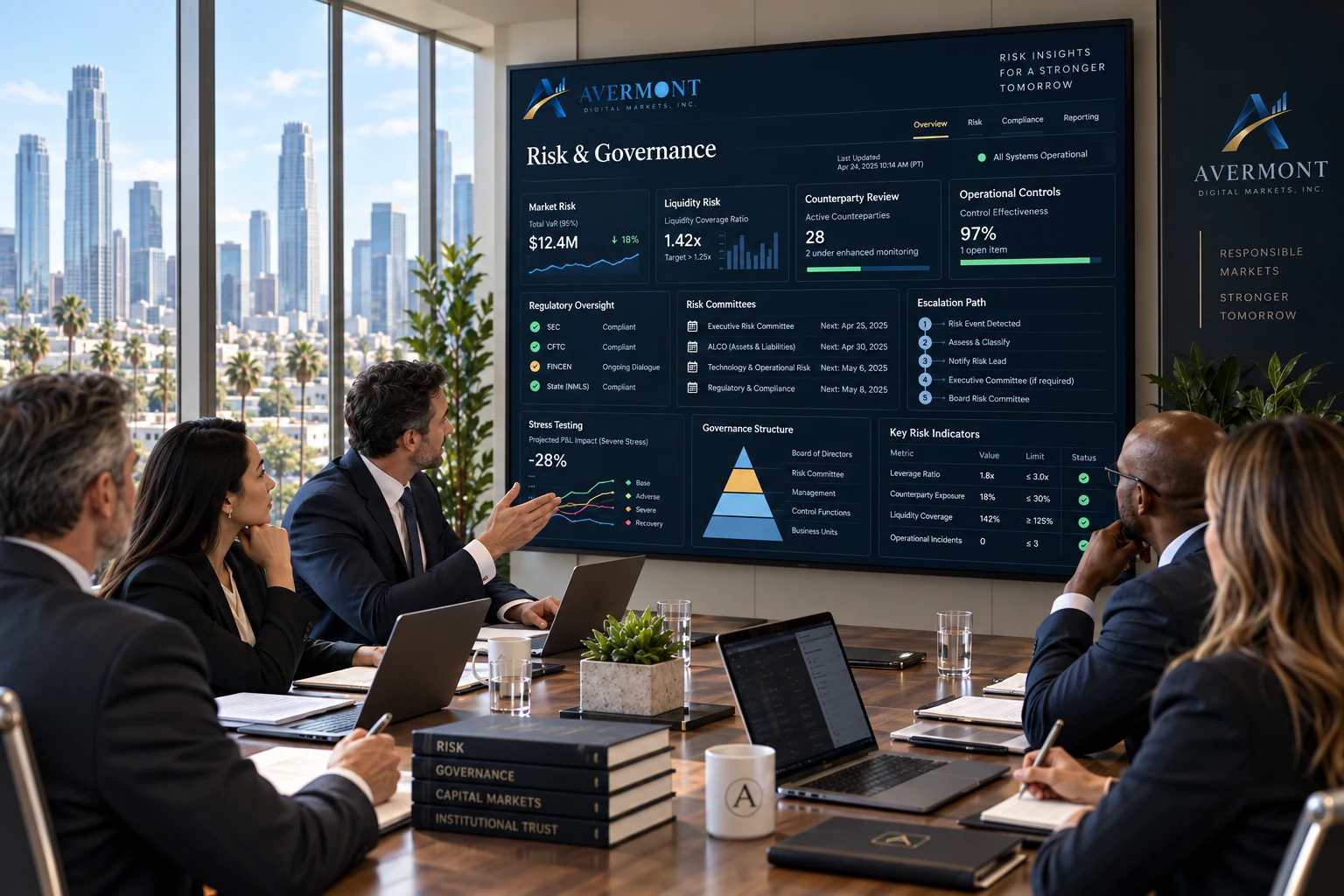
Digital-asset markets concentrate several types of risk in the same transaction. The framework is therefore designed around interaction, not isolated checklists.
Directional exposure, Greeks, volatility, basis and stress sensitivity.
Depth, spread, market impact, liquidation horizon and stressed liquidity.
Exposure, concentration, credit quality, settlement structure and limits.
Margin sufficiency, collateral quality, concentration and liquidity buffers.
Process controls, reconciliations, approvals, exceptions and business continuity.
Availability, access, change management, monitoring and security controls.
Payoff behavior, lifecycle events, model assumptions and operational complexity.
Applicable requirements, disclosures, communications and governance standards.
A functioning governance model defines who can approve risk, who can escalate it and who has authority to stop or reduce activity when thresholds are breached.
Sets strategic expectations and receives material risk reporting.
Owns business decisions, resource allocation and cross-functional accountability.
Define limits, challenge assumptions, monitor exposures and escalate exceptions.
Operate within approved boundaries and own first-line controls.
Tests whether controls, documentation and operating practices remain effective.
The strongest frameworks connect pre-trade limits, live monitoring and post-trade review into a single feedback loop.
Risk appetite, limits, approved products, counterparties and escalation thresholds.
Exposure, Greeks, liquidity, collateral, concentrations and scenario outcomes.
Track live conditions and operational exceptions against defined thresholds.
Move issues to the right authority before they become larger problems.
Use incidents, near misses and market events to improve controls and policy.